Map
An open-world island of brightly colored monuments, puzzle structures and towers — no map screen or quest markers.
Big Walk's map is an open-world island filled with brightly colored monuments and structures, traversed on foot with no quest markers, no map screen, and no fast-travel for much of the game. Getting lost is not a failure state — it is a core part of the experience, and reviewers describe the act of navigating, reuniting, and stumbling onto puzzles as some of the best moments in the game. Here is what we know about Big Walk's world layout, its landmarks, and how getting around actually works.
An Open-World Island
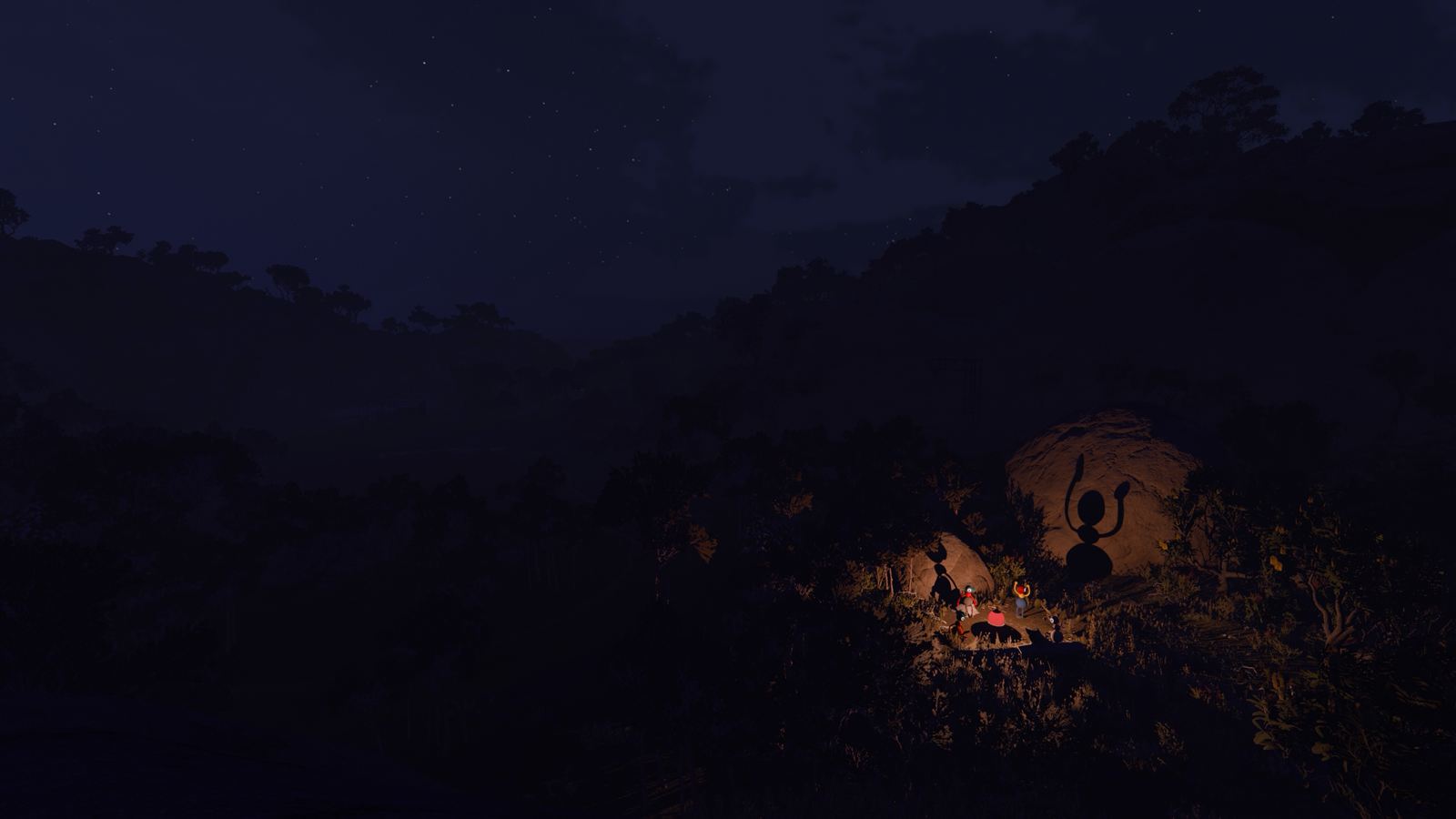
Big Walk drops your group onto an open-world island that you explore freely. There is no linear level select and no corridor structure — you wander a continuous space, discovering puzzles and landmarks by sight. The world is hand-crafted rather than procedurally generated, meaning every monument and vista is intentionally placed. Kotaku describes the setting as an uninhabited island — your group are the only people there — with trees, mountains of varying heights, valleys, rivers, and coasts, and no signs or trail markers anywhere.
The island supports a day-night cycle, with sun-soaked days and pitch-dark nights, and the nights genuinely change how you navigate: without a flashlight or a flare, your group can lose sight of each other entirely. Reviewers describe the world as colorful, inviting, and slightly surreal — a place designed for ambling exploration rather than efficient routing. IGN's verdict on the layout is that "the map is cleverly designed to nudge your group to build something together."
Brightly Colored Monuments As Landmarks
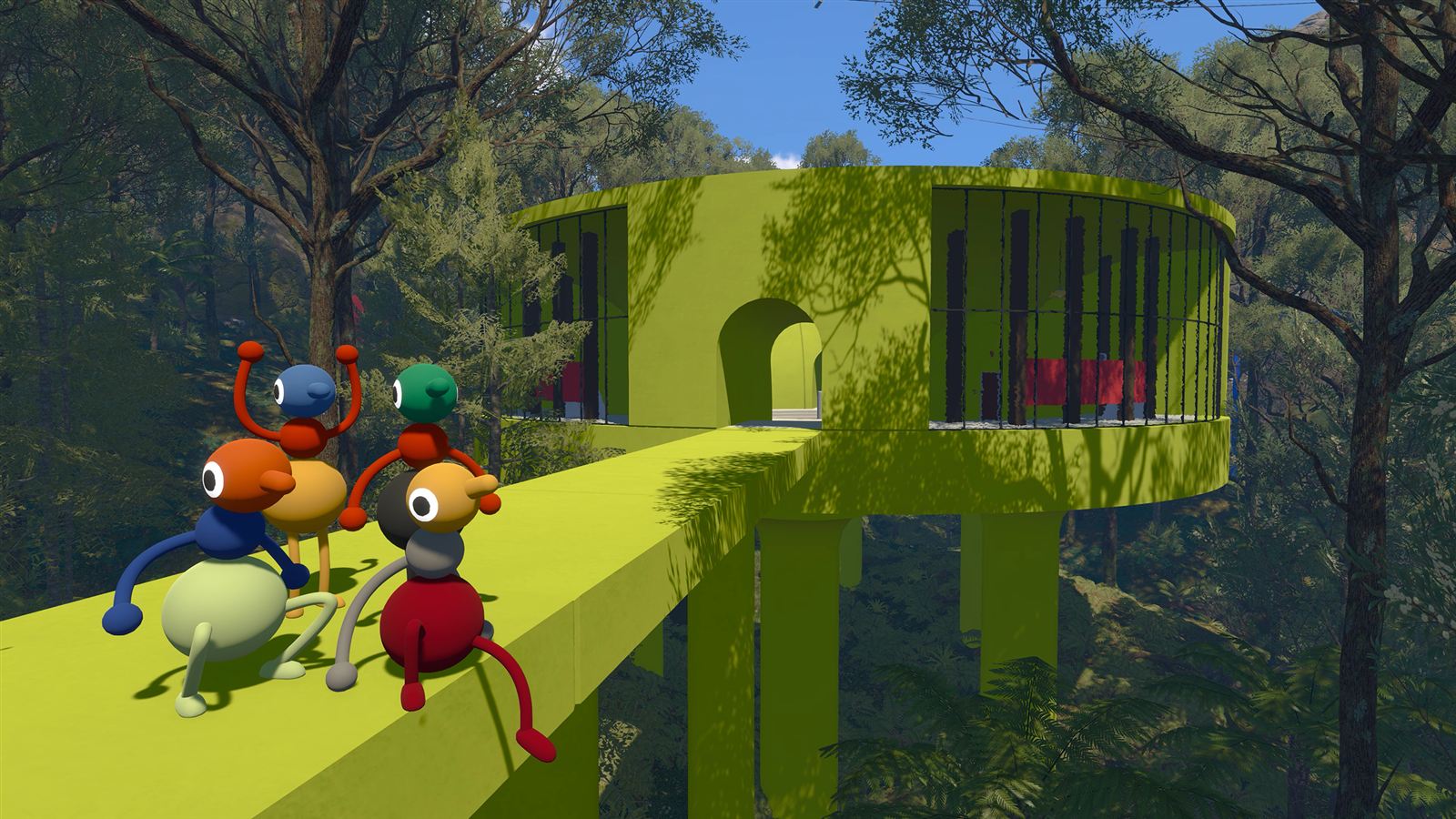
Because there is no map screen, Big Walk's colored monuments double as your navigation system. The puzzle structures are large and vividly painted — a green horror house, an orange colosseum, a blue sound stage, a towering blue spiral, a giant jungle gym, among others — and you learn to orient yourself by them. Kotaku compares them to giant toys spaced out across the landscape. Spotting a familiar color on the horizon tells you where you are and what is nearby.
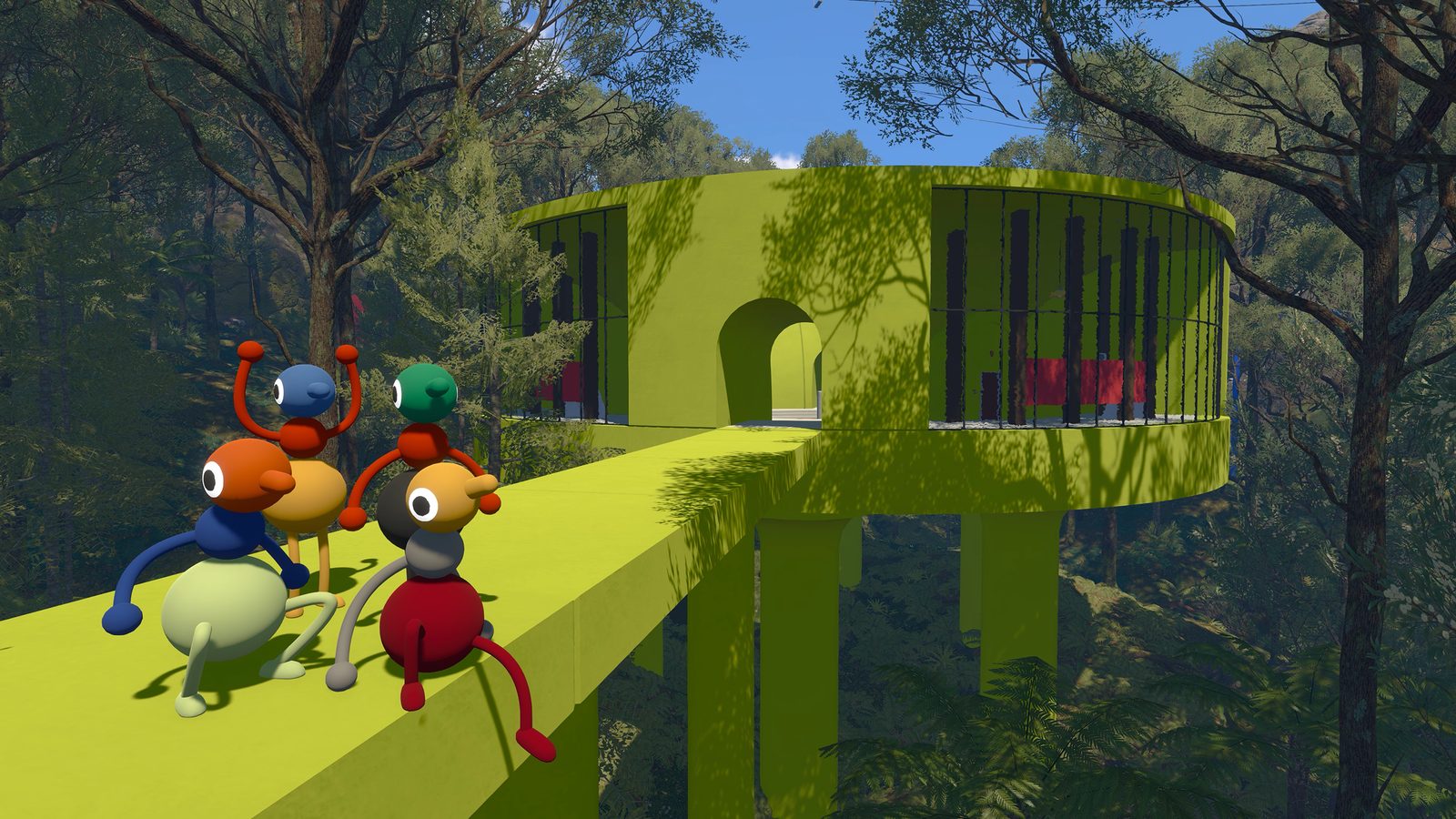
This is a deliberate design choice: rather than giving you a minimap, the game trains your group to build a shared mental map of the island and to use landmarks to coordinate. "I'm near the orange thing" becomes genuinely useful information. The same goes for the four colored mountaintop towers — red, blue, green, and yellow — which are tall enough to see from far away and become reference points in their own right.
Yes, There Is A Map — You Have To Find It
One nuance that trips up new players: Big Walk has no on-screen map at the start, but the game does contain a real, physical map of the island. To get it, your group must leave the tutorial area, solve puzzles, and unlock the Red Tower — the one that sticks out against the greenery. Deposit your collectibles at the console atop its stairs, shape the key, follow the arrows, and you eventually reach a big blue tunnel.
Inside is a massive three-dimensional map of the island, which players report marks the areas you have completed and shows where collectibles are located. There is also a smaller carryable map on a red table in the same room — stash it in a backpack or belt, or simply carry it in your hands. Until you make this trip, landmarks and dead reckoning are all you have, which is exactly the friction the game wants.
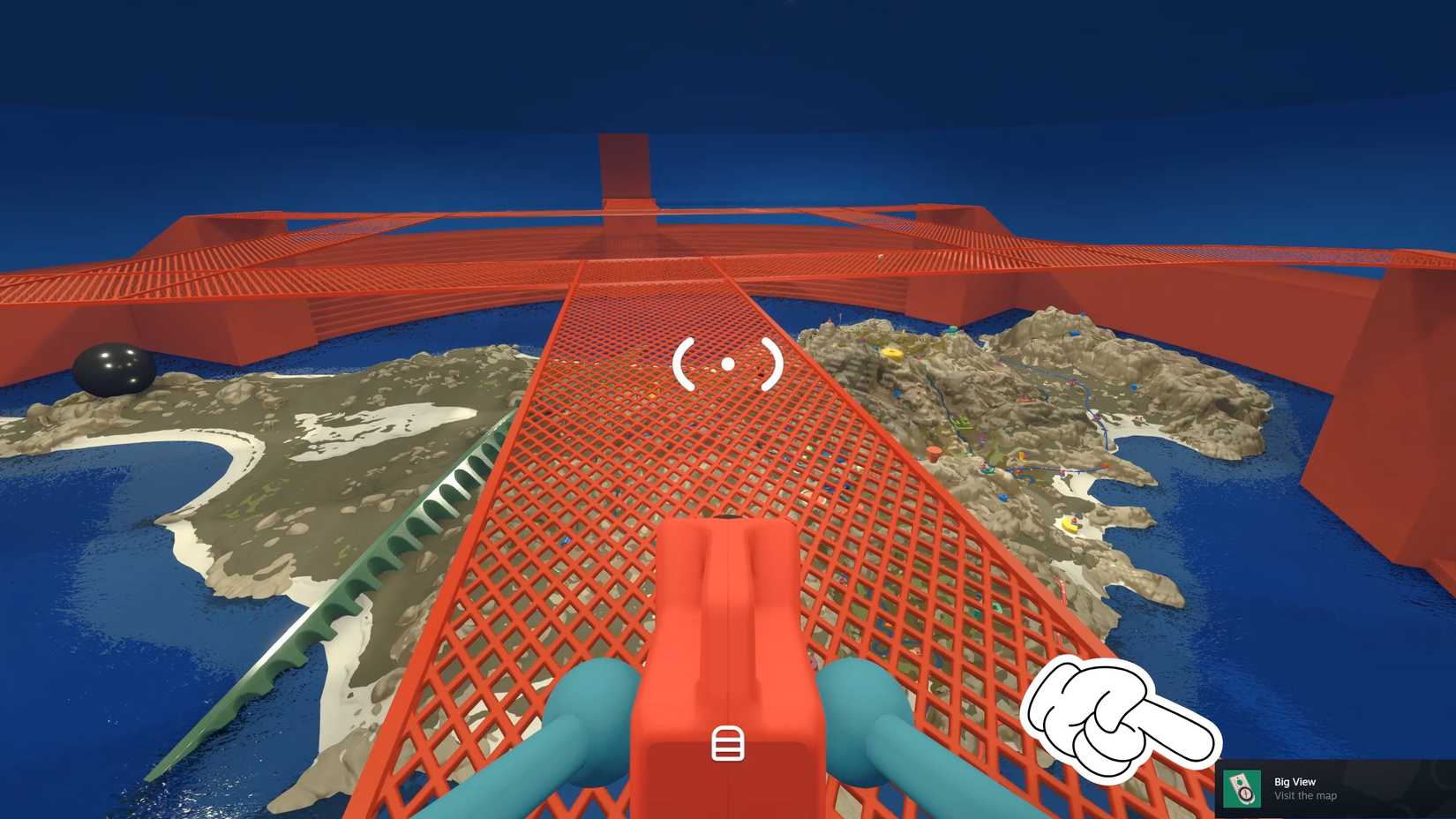
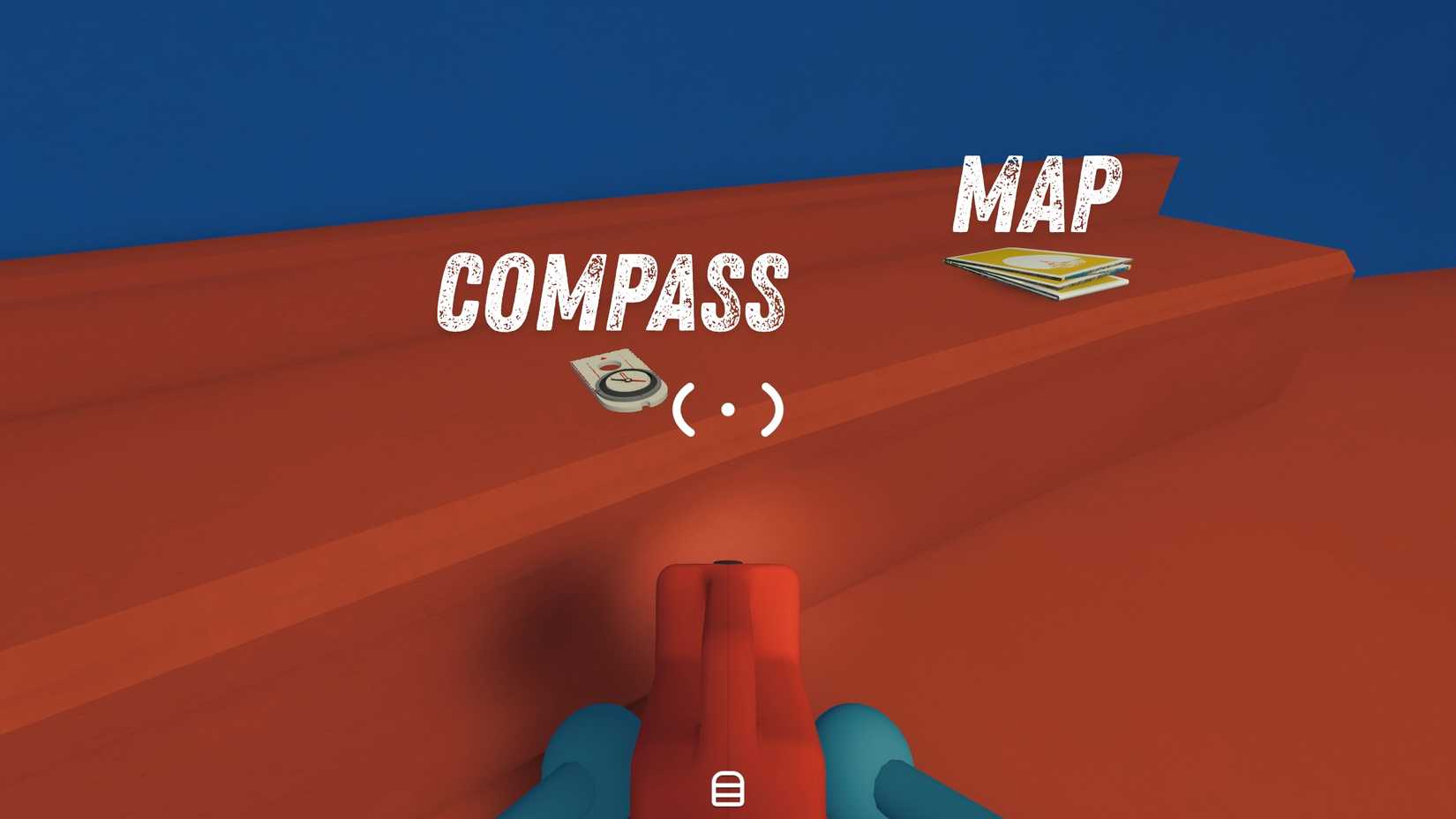
For the full step-by-step of unlocking that room — the five Red Tower puzzles, the key filing, the door — see our Red Tower walkthrough.
Towers And Progression Gates
Scattered across the island are towers where you deposit collectibles (red beans and gourds gathered from puzzles) to earn keys. These towers function as both progression checkpoints and physical landmarks — tall structures visible from afar that also mark where your group needs to converge. Earning keys at towers unlocks new areas and new modes of travel, gradually opening the island up.
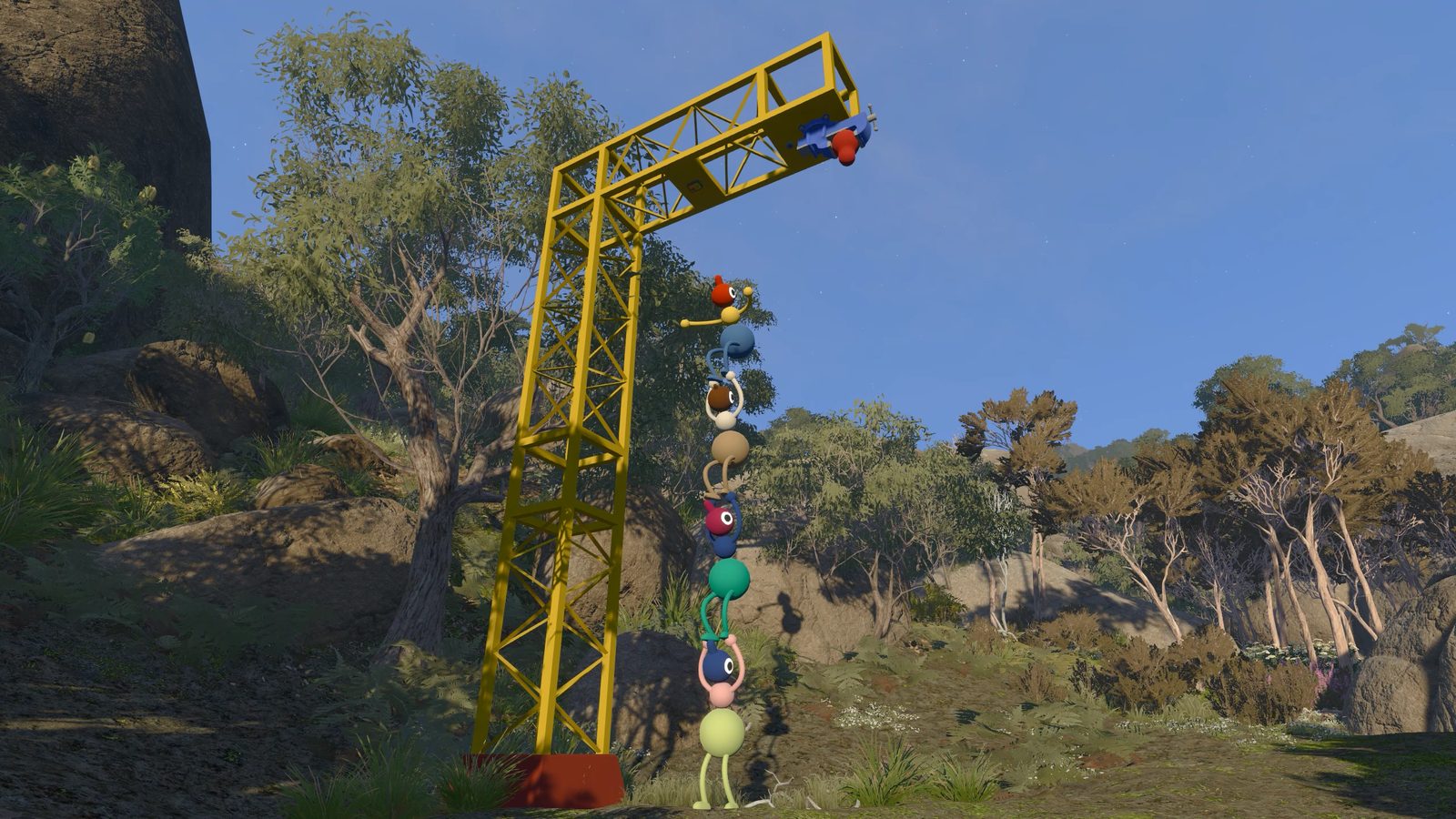
The towers are practical wayfinding tools, too. Each has a radio station you can use to speak with anyone carrying a walkie-talkie, and a flare stationed at the top that you can fire to signal your position to the rest of the group. IGN's group found each other after an hour of being lost by walking toward a flare one member was launching from a puzzle site.
No Quest Markers, On Purpose
Big Walk has no quest markers, no objective arrows, and no map screen in the conventional sense. This is one of the most consistent things reviewers emphasize: the game refuses to tell you where to go. Part of the fun is the friction of figuring it out together — describing landmarks over voice chat, deciding which direction to head, and dealing with the chaos when the group gets split up.
Beyond the towers, the island offers other legalized shortcuts for a scattered group: seven radio stations tied to green transmitters (push the red button to raise the antenna and unlock the station), signs you can write on and read from a distance with binoculars, and light signals from flashlights or the island's bouncy bulbs — one blink for yes, one steady light for no, if your group agrees on the code. Once the train is running, every station also displays a real-time board showing where the train is, so you can decide whether to wait for it or walk.
If you are the type of player who relies on waypoints, Big Walk will feel disorienting at first. That disorientation is the point, and it fades as your group builds familiarity with the island.
Getting Lost Is The Game
Multiple reviewers single out getting lost as a highlight. The moments between puzzles — wandering, regrouping, stumbling onto something unexpected — are described as some of the most joyful parts of Big Walk. The game is built for groups that enjoy the journey, not just the destination, and a crew that treats the open world as a playground will get far more out of it than one trying to optimize a route.
The flip side is that reuniting a scattered group takes real coordination, since you cannot just ping a location. Proximity voice chat — voices that fade with distance — is your primary tool for finding each other again, with flares, horns, and cowbells as backup. Kotaku's review argues the game is as much about loneliness as connection: being alone in the dark, unsure whether anyone can hear you, is part of the design.
Movement Friction On Terrain
One practical navigation note: movement can be finicky on uneven ground. Reviewers report that walking uphill or over rocky terrain sometimes snags your character, a minor frustration when you are already lost. It is a small blemish on the exploration, usually forgotten the moment something new grabs your attention.
FAQ
Is there a map in Big Walk?
Not on screen at first — but yes, a physical one exists. Complete the Red Tower chain to unlock the Map Room next to the starting hub, which holds a full 3D island diorama plus a carryable foldable map and compass. Our Red Tower walkthrough covers every step.
Does Big Walk have fast travel?
Not for most of the game. Later progress unlocks new modes of travel (including a train between stations), but there is no waypoint-based fast travel, and the game never adds quest markers or a minimap.
How big is Big Walk's map?
House House has not published exact dimensions. It is a single hand-crafted island — big enough that reviewers report being genuinely lost for an hour, compact enough that the colored towers stay visible from most of the terrain.
How do you navigate without a map?
Colored monuments and the four colored towers (red, blue, green, yellow) are the reference points, backed by proximity voice chat, flares, walkie-talkies and the seven radio stations. Our tools and items guide covers where to get the gadgets that help.
Can you see where other players are?
There is no player-marker overlay. You locate each other the diegetic way: voice, flares fired from tower tops, radio music, or arranged light signals — one blink for yes, a steady light for no, if your group agrees on the code.
Summary
Big Walk's map is an open-world island with a day-night cycle, navigated by brightly colored monuments and towers rather than a map screen or quest markers. There is no fast-travel for much of the game and no objective arrows — getting lost is an intentional, celebrated part of the experience. Landmarks like the green horror house, orange colosseum, and blue sound stage serve as your navigation reference points, and while a physical 3D map and a carryable version can be found via the Red Tower, the primary tools are proximity voice chat, flares, radios, and your group's shared mental map. Movement on rocky uphill terrain can occasionally snag, but the wandering is the point.
Sources
- Big Walk official press kit — bigwalk.game/presskit (island screenshots; landmark and tower images above are official screenshots, credit House House/Panic)
- GameRant — Big Walk Red Tower Solution & Map Location (Big View Trophy) by Ayyoun Ali, August 4, 2026 (Map Room and diorama details; Map Room screenshots above are from this article, used with attribution)
- PC Gamer — Big Walk: So, what's the deal with that number puzzle? by Christopher Livingston, August 8, 2026 (the map's coordinate grid)
- Kotaku and IGN reviews — island layout, no-marker design, radio stations and flare navigation (quoted in the text above)
RELATED BIG WALK TOPICS
These related pages complete the picture:
All Puzzles
Solve puzzles for red beans and gourds, deposit them in towers for keys, and unlock new areas like the train and chair lift.
GID-054166 1899 Puzzle
4166 and 1899 are not a code — they are coordinates pointing to a hidden button. Solve it with the map or the GPS.
GID-07Tools & Items
Every Big Walk tool and where it lives: the map and compass in the Map Room, the GPS by the green tower, walkie-talkies, binoculars and backpacks.